Magua
The Last of the MohicansMagua is a Huron leader whose political calculation and personal vendettas make him one of the novel’s principal antagonists. Called Le Renard Subtil by his Canadian allies, he repeatedly turns apparent cooperation into advantage, and his final pursuit of Cora ends with his death during an attempted escape from Hawkeye.
Identity and Reputation
Magua takes pride in the name Le Renard Subtil, which his Canadian allies have given him, and presents himself as a figure of exceptional ability: he boasts that night is no obstacle when Colonel Munro is waiting for him. His reputation rests not only on cunning but also on courage and oratorical skill. Even when his standing among the Hurons has been weakened by his desertion and personal failings, he can command an audience and persuade listeners.
His relationship with the French is strategic rather than simply obedient. Magua tells Montcalm that he took up the hatchet to stain it with blood, but accepts the French commander’s claim that the English have agreed to leave and are no longer enemies. At the same time, he says that his pledge requires him not to attack France’s enemies across the sea and to treat the Hurons’ friends as his own. The exchange presents him as a political actor negotiating the limits of an alliance, not merely as an instrument of French policy.
Deception and Conflict
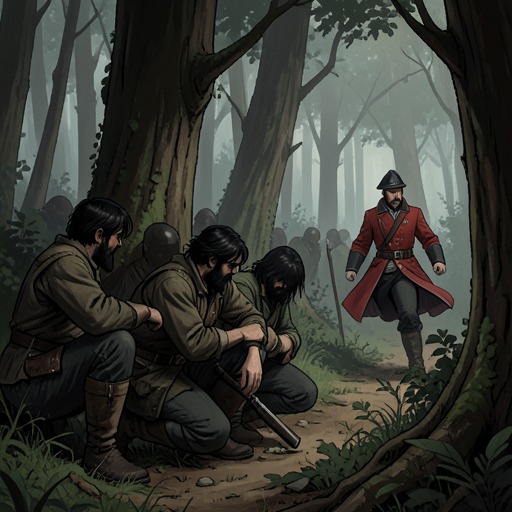
During the journey with Duncan Heyward, Magua refuses to accept Heyward’s suggestion that nightfall has made further progress toward William Henry impossible. When Heyward offers him a wallet and attempts to touch his arm, Magua abruptly breaks away and escapes into the thicket. Chingachgook pursues him, Uncas gives the alarm, and a rifle shot follows. The episode establishes the pattern of apparent negotiation giving way to flight and pursuit.
That pattern returns after the captives are seized. Magua stands apart from the Hurons who are occupied with plunder, his composure revealing to Heyward that he has already achieved the purpose of his betrayal. Heyward recognizes his former guide among the captors and addresses him despite his revulsion. In a later encounter, Heyward’s horror at meeting Magua again underlines how the earlier betrayal has shaped their conflict.
Alliances, Revenge, and Oratory
Magua’s political loyalties shift with circumstance. At one point he explains that after he left his people, his wife was given to another chief; he says that he has now made friends with the Hurons and will return to his tribe’s graves by the great lake. He asks that Cora follow him and live in his wigwam. The proposal joins his asserted return to his people with his demand to take Cora, making their conflict both personal and political.
When a Huron captive’s words strike at the tribe’s honor, Magua recognizes the opportunity and answers with a forceful public speech. He invokes the dead Huron warriors, describing them as having left without the provisions and equipment needed for their journey to the happy hunting-grounds. He urges his listeners not to forget the dead and proposes that the Mohican captive be sent after them with gifts. His appeal turns mourning into a collective demand for vengeance, showing how he uses shared memory to move the tribe toward action.
Magua also frames political choices through praise of Huron courage and wisdom. Before the gathered warriors, he flatters his audience, recalls their past responses to insult, and presents discretion as a quality distinguishing the Hurons from other peoples. His speech makes strategic restraint sound like a proof of superiority, demonstrating that his influence depends on more than anger: he can redirect communal pride toward a calculated decision.
Final Pursuit and Death
During the battle between the Delawares and Hurons, Magua remains conspicuous among a small group of Hurons retreating up the slope rather than seeking cover. Uncas abandons the wider pursuit when he sees him and rushes toward his enemy with several warriors. Magua initially waits for the attack, then retreats as Hawkeye and the other white companions arrive in support of Uncas.
The pursuit continues through a thicket and into a cave already known to the pursuers. Hawkeye holds back from firing while Uncas is close to Magua, and Magua briefly appears ready to make another attempt before fleeing again. Cornered near a precipice, he demands that Cora choose between joining him and death. As he tries to climb out of reach, Hawkeye steadies his rifle and fires. Magua loses his hold and falls from the mountain, ending the rivalry that has shaped the final pursuit.
Narrative Role
Magua’s characteristic strength is the ability to convert grievance into political influence: he exploits divided alliances, speaks to collective memory, and pursues private aims through public conflict. The narrative also places his choices within a frontier war in which colonial maneuvering has unsettled older relationships. Hawkeye observes that white political cunning has confused the distinction between friends and enemies, divided the Delawares, and encouraged conflict among peoples who share ties of language or history. Magua’s shifting alignments embody that disorder, while his final defeat closes the personal pursuit without resolving the larger losses and divisions of the frontier.